Establish what the workshop is being asked to demonstrate
The word calibration is often used in workshops to describe several activities at once: measuring an injector, adjusting it, checking the result and generating a compensation code. That everyday usage can hide important differences. Before interpreting a service description, ask which activities are included and what document records each outcome. A measurement report, an adjustment record and an injector code do not answer the same question.
There are also two different kinds of code to keep separate. A diagnostic trouble code belongs to the vehicle's monitoring system and records a detected condition. An injector compensation code belongs to the fuel-control strategy and conveys applicable injector characteristics. Clearing a diagnostic code does not create a compensation code. Equally, entering a compensation code is not evidence that the vehicle's original diagnostic concern has been resolved.
Testing asks how the component behaves under defined conditions
A component test applies specified inputs and records the relevant response. An injector plan may examine delivered fuel, return flow, sealing or electrical behaviour at selected operating points. The applicable pressure, drive strategy, temperature and collection method belong to that plan. The result is meaningful because those conditions are known, not simply because the bench displays a precise-looking number.
A delivery figure without its unit and measurement basis is incomplete. Quantity per injection, quantity collected over a stated number of events and flow per unit time are different ways of reporting a result. Two figures cannot be compared responsibly until their basis and conditions match. The same applies to return-flow values: the route measured and the imposed return conditions must be identified.
A pass means the evaluated characteristics met the stated criteria using the stated method. It does not mean every possible characteristic was measured or that unrelated engine faults were excluded. A failure should likewise prompt interpretation of the setup, component and evidence rather than an automatic repair decision from a single number.
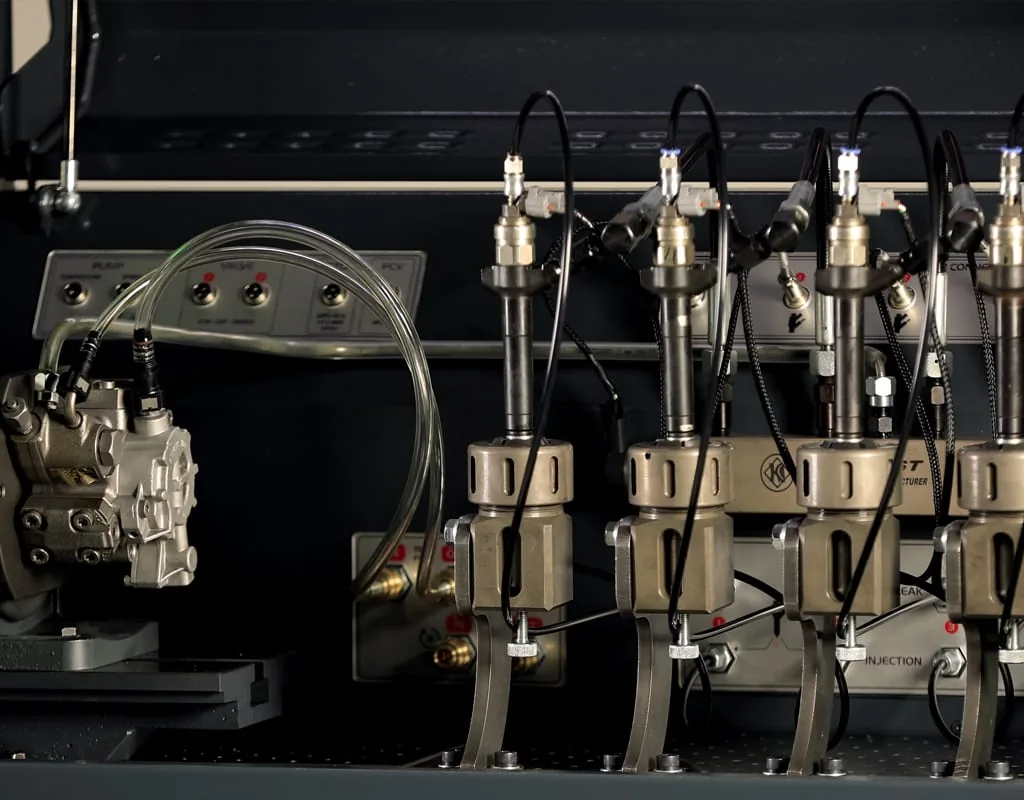
Pump and injector fixtures in a KOMTEST CRI PUMP 2400. The photograph provides equipment context; it is not a test result, calibration record or connection procedure.
Open the full-size image (new tab)Characterisation describes a response across operating points
Characterisation builds a description of behaviour from measurements across relevant conditions. For an injector, that can include how delivery changes with pressure and commanded duration, or how response varies over the part of its operating range covered by the method. It is more informative than treating the component as one fixed flow value. The particular characteristics and points required depend on the injector family and purpose of the test.
A graph makes the relationship easier to see, but its axes, conditions and data quality still matter. A delivery curve is not automatically a spray-distribution measurement, and electrical response is not automatically proof of correct hydraulic delivery. A characterisation may support evaluation or a supported coding process, yet it does not itself change the injector. If a component is repaired or adjusted, earlier measurements must not be assumed to describe its resulting condition.
Measurement calibration and component adjustment are different
In measurement science, calibration establishes how instrument indications relate to reference values under specified conditions, with measurement uncertainty considered. Adjustment changes a measuring system's response. Neither term should be used as a substitute for the other. In an injector workshop, the measuring equipment and its measurement assurance are distinct from work performed on the injector.
Component adjustment means changing a permitted setting or part relationship to achieve the required behaviour, where the relevant service process allows it. Repair can involve a different intervention. Both need subsequent evaluation appropriate to the work. A repeatable reading alone is not proof of accuracy: repeated results can share the same bias. Useful evidence therefore includes the test method and the condition of the measurement system, not just agreement between successive runs.
| Activity | Main purpose | What it does not establish alone |
|---|---|---|
| Testing | Measure and evaluate selected characteristics | The health of every system on the vehicle |
| Characterisation | Describe behaviour across relevant conditions | That a physical adjustment was made |
| Measurement calibration | Relate indications to reference values | That the injector was repaired |
| Component adjustment | Change permitted settings or relationships | That the resulting behaviour meets requirements without retesting |
| Compensation coding | Represent characteristics in the supported control format | That the ECU has received the code |
| Vehicle registration | Associate the applicable code with the correct installed position | That an underlying mechanical fault was repaired |
A compensation code carries control information
Injectors of the same reference can show small differences in measured response. Where the application uses compensation coding, the controller uses the applicable correction information to account for defined differences in its fuelling strategy. A supported code-generation method translates the required measurements into the appropriate format. The format and measured characteristics are specific to the injector and control strategy; an arbitrary string is not a valid substitute.
A code cannot repair worn or damaged hardware, and coding should not be described as a way to make an out-of-specification injector acceptable. If repair changes relevant characteristics, the earlier code must not simply be assumed correct. The service process determines how the resulting injector is evaluated and what compensation information is required.
Do not assume every application uses an individually unique code. Some replacement strategies use application-specific generic compensation data. The correct question is whether the supplied or generated information is appropriate to that exact component and application, not whether its printed characters differ from every other injector.
Vehicle registration completes a separate task
Where required, vehicle registration records the applicable compensation information in the control unit for the correct installed injector position. It normally uses the supported vehicle diagnostic function. This operation is separate from generating the information on a component test system. Reading a label, generating a code and successfully registering it are three different outcomes; the records should make that distinction clear.
Additional learning or adaptation functions depend on the engine and service procedure. They should not be promised as a universal substitute for registration or as a cure for a mechanical defect. Likewise, a control unit accepting a code proves neither that the injector reference is appropriate nor that the component has passed the necessary hydraulic tests.
A useful final record connects component identity, test-plan identification, measured results, evaluation, any permitted work, the applicable compensation information and any required vehicle-side operation. Together they explain what was demonstrated. Engine behaviour must still be checked through the relevant vehicle procedure; neither an impressive report nor a quiet idle alone establishes every aspect of a successful repair.
KOMTEST Technical Learning
Key takeaways
- Ask which operation was performed and what evidence records its result.
- Keep measurement calibration, component adjustment and compensation coding distinct.
- Check the complete chain from component identity to the required vehicle-side registration.
Questions & answers
A closer look.
Does testing automatically generate a new injector code?
No. Testing and code generation are separate functions. Whether coding is needed and supported depends on the exact injector, test method and vehicle application.
Can an old code be reused after any repair?
It should not be assumed suitable. Work can alter the characteristics described by the code. Follow the applicable evaluation and compensation process for the resulting component.
Does an ECU accepting the code prove the injector is good?
No. Acceptance records a successful data operation within that function. Component identity, hydraulic condition and the wider vehicle diagnosis require separate evidence.
Technical glossary
- Characterisation
- A measured description of behaviour across specified operating conditions.
- Compensation code
- Application-specific information used by a controller to account for defined injector characteristics.
- Registration
- Recording the required injector information against the appropriate installed position in the vehicle control system.
- Measurement uncertainty
- A parameter describing the dispersion of values that can reasonably be attributed to the quantity being measured.